

I Don’t Look at Classrooms the Same Way Anymore
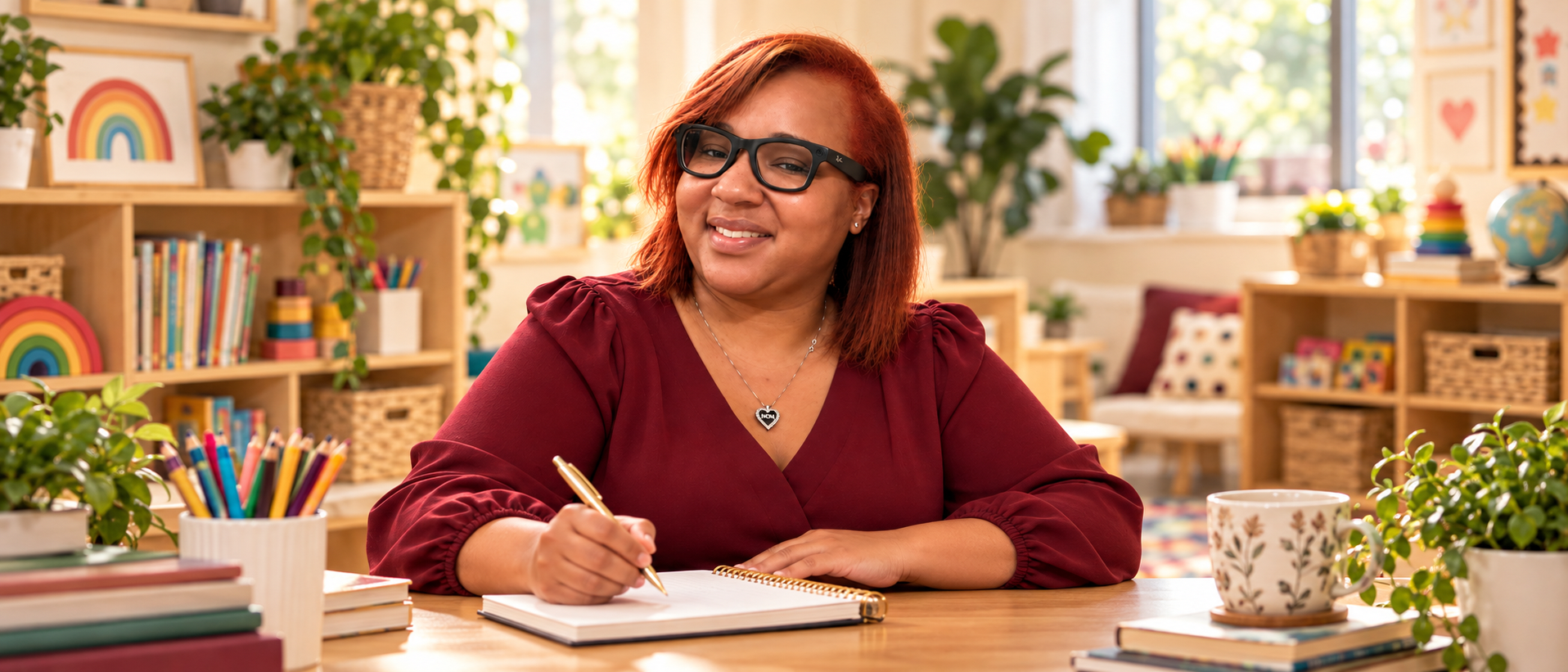
RaChe’ seated at a classroom table with a notebook, smiling toward the camera in a warm early childhood learning environment.
#WhatRaCheSaid Journal
There was a time when I could walk into a classroom and immediately start looking at the setup. The areas. The materials. What was on the walls. What we were studying. What I wanted children to be able to explore. What I wanted somebody to understand about our classroom just by walking into it.
I still notice those things. But I do not look at classrooms the same way anymore.
My eye has changed as my role in early childhood has changed.
When I was a classroom teacher, I almost thought of the environment like our playground. It was where the children and I explored learning together. I wanted children to have areas where they could move, play, investigate, make choices, and use materials. I also wanted the learning we were doing together to live beyond one lesson or one part of the schedule.
If we were learning about letters, maybe we were looking for letters or sounds around the room. If we were talking about colors or shapes, maybe we were noticing them in our environment. If children created something connected to what we were learning, I wanted us to be able to come back to it later and say, “Remember when we talked about this? What did you notice? What did you draw? What were we thinking about when we made this?”
I wanted the room to help us keep the learning going.
And honestly, I wanted somebody walking into my classroom to be able to tell that learning was happening there. Not because everything needed to be perfect, but because the classroom should have had some relationship to what the children and I were actually doing.
When My Role Changed, My Questions Changed
As I moved into coaching, coordination, management, and program leadership, I started seeing classroom environments differently.
I was no longer only asking, Does this look like a good classroom setup?
I started asking, Does this setup actually work for the children who are here right now?
That became important because one group of children may move through a classroom one way, and the next group may need something different.
Maybe last year’s children could enter the classroom, put their belongings away, wash their hands, and move into the next part of the routine with very little adult support. Then a new group comes in.
Same classroom. Same cubbies. Same sink. Same routine.
But now those children may need an adult greeting them more intentionally. Maybe they need more modeling. Maybe they need a visual cue. Maybe they need more practice. Maybe the setup itself needs to change.
That does not mean the classroom was wrong before.
It means the children changed.
And when the children change, sometimes the environment and the adult support need to change too.
That was an important shift for me.
The classroom is not something we finish in August and then expect every child who enters it to figure out.
Children Have to Learn the Environment Too
Sometimes as adults, we forget how much we already know about a classroom.
We know where everything belongs. We know what each area is for. We know which materials children can use independently. We know where we want things returned. We know what happens after breakfast. We know where children go during small group. We know what we intended when we arranged the shelf.
The children do not automatically know any of that because we arranged it thoughtfully.
They have to experience it. They have to explore it. They have to learn how the room works.
And adults are part of that learning.
We introduce the space. We model. We answer questions. We ask questions. We help children make connections. We notice how they interact with the materials, where they naturally go, what they avoid, what kinds of play begin to develop, and what conversations start happening in different areas.
All of that gives us information.
The environment may create opportunities, but the adults and children bring those opportunities to life.
I Am Looking at the Adults Too
This is another way my eye has changed.
I am not only looking at what the children are doing. I am looking at how the adults are working inside the room too.
Where are they positioned? Can they see what they need to see? Are both adults standing in the same area while another part of the classroom is harder to supervise? Are they working together so one person’s position complements what the other person cannot see?
And beyond supervision, are adults able to interact with children, ask questions, support play, and notice learning? Or is the setup requiring them to spend most of their time managing the room?
Sometimes we see a teacher moving back and forth all day, constantly redirecting, retrieving materials, solving the same problem, or telling children the same thing.
My first question is not automatically, What is the teacher doing wrong?
I also want to ask:
A question I carry now
What is the environment asking the teacher to carry?
Are materials placed in a way that means children always need adult help? Is there a sightline issue? Is an area difficult to supervise? Does something that looks good from one side create a problem somewhere else?
Sometimes teacher practice needs support.
Sometimes the environment needs an adjustment.
Sometimes both are contributing to what we are seeing.
That is why I do not like looking at either one by itself.
Families See the Environment Too
There was another layer that became more important to me as I moved into leadership.
Families are experiencing the classroom too.
They may not know the lesson plan. They may not know why a particular material was added. They may not know the professional language behind what educators are doing.
But they can walk into a room and begin noticing what their child has been experiencing.
That made me think more about whether the classroom gives families some way into the learning.
Can they see children’s work in a meaningful way? Can a child point to something and say, “We did this,” “We read this book,” “I made that,” or “That’s what we were talking about”?
Can teachers use something in the room to help start a conversation with a family?
For me, that is more meaningful than filling every wall.
I want the environment to help tell the story of what is actually happening there.
What I Notice Now
I still notice the shelves.
I still notice the materials.
I still notice the displays.
I still want to know what children are learning.
But now I am also watching what happens between the people and the space.
Can children actually use this space?
Can educators actually work in it?
Does it support supervision?
What are children learning here?
How are the adults helping that learning grow?
What is easy for children to use independently?
What keeps requiring adult support?
What does the teaching team have to do all day to make the environment work?
And when something is not working, where does the adjustment really need to happen?
The environment?
The practice?
Or both?
That is why looking at classrooms has become more interesting to me over the years.
I am not just looking at the room anymore. I am looking at the relationship between the room, the children, the educators, and the learning.
I do not look at classrooms the same way anymore.
And I think that is a good thing.
Because the longer I have worked in early childhood, the less interested I have become in whether a classroom simply looks right.
I want to understand how it is actually being lived in.
By the children.
By the educators.
By the families who enter it.
That tells me much more about what the environment is really doing.
