

#WhatRaCheSaid Journal - Let Children Show You
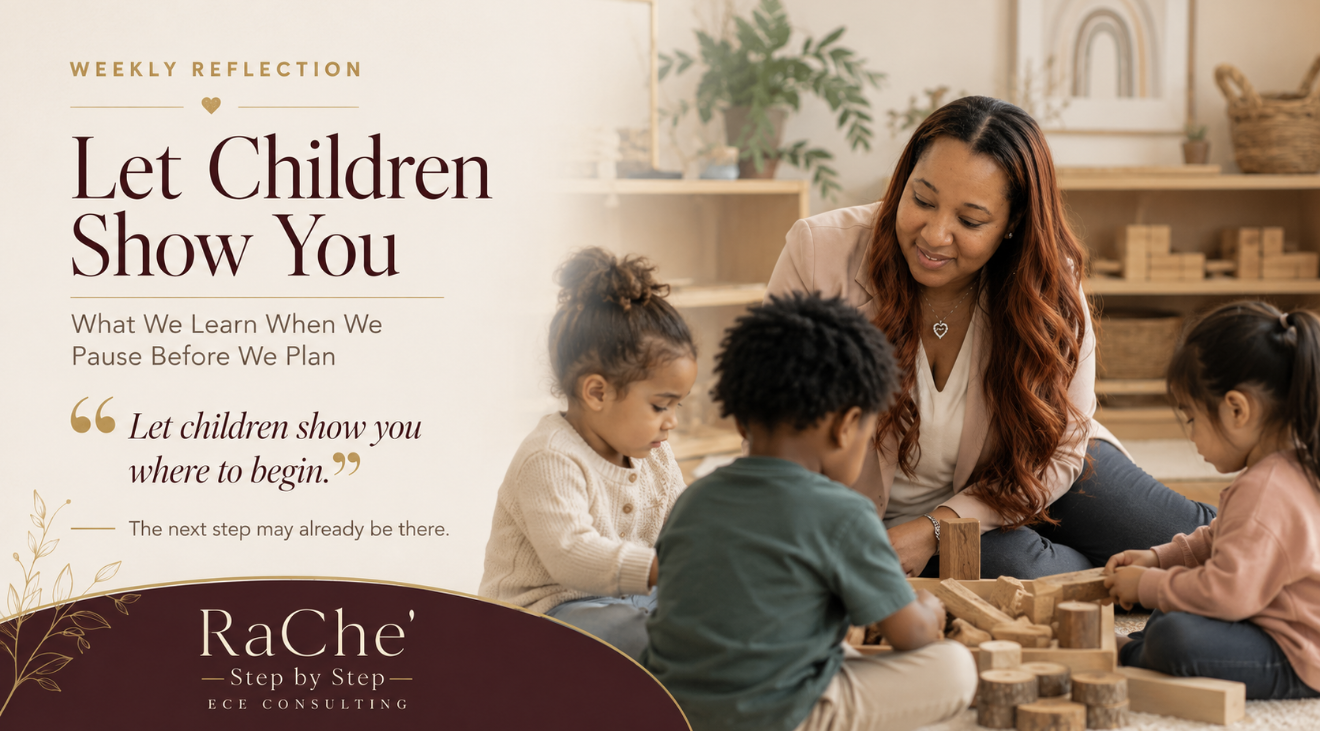
RaChe’ sits with three young children in a warm early childhood classroom as they explore and build with natural wooden materials. The image reflects responsive teaching, thoughtful observation, and allowing children’s interests to help guide the next step in learning.
Let Children Show You: What We Learn When We Pause Before We Plan
Lately, I have been thinking about how quickly adults move toward an answer.
We see children gathering in one corner, and we start rearranging the room.
We notice they are not using an activity the way we expected, and we begin planning something new.
A child asks the same question again, and we assume they were not listening.
The block area becomes crowded. Dramatic play turns into a grocery store for the fourth day in a row. A carefully prepared experience sits untouched because somebody found a bug.
And almost immediately, we want to decide what should happen next.
I understand why.
Early childhood educators are carrying a lot. We are planning, supervising, guiding, documenting, communicating with families, supporting behavior, managing routines, and trying to make the day meaningful for every child in the room.
There is not always time to sit quietly and wonder about every moment.
Sometimes a decision has to be made.
Sometimes the adult does need to step in.
Sometimes the space needs to change, the materials need to be adjusted, or the experience needs to end.
But I also believe there are moments when we move too quickly because we feel pressure to have an answer.
We think being intentional means always knowing what comes next.
Sometimes the most intentional thing we can do is pause long enough for the children to show us.
Children Are Giving Us Information All Day
Children may not sit down and explain exactly what they need from an experience.
They show us in other ways.
Through what they return to.
What they avoid.
What they repeat.
What they talk about.
What they build.
What they pretend.
What they carry from one area to another.
What they watch before deciding to join.
A child who returns to the blocks every morning may not need us to redirect them toward something “new.” They may still be working through an idea that has not finished developing.
A dramatic-play area that keeps becoming a grocery store may be telling us something about children’s familiar experiences, relationships, language, or interests.
A child who continues asking the same question may not be trying to test our patience. They may still be making sense of the answer.
A group using materials in a way we did not plan may not be using them incorrectly. They may be showing us another possibility.
Those moments are information.
Not instructions we must follow automatically.
Not proof that every repeated interest needs to become a six-week project.
Just information.
And when we pay attention to it, our planning becomes more connected to the children who are actually in front of us.
Observation Does Not Mean Doing Nothing
Pausing does not mean the adult disappears.
It does not mean children are left without boundaries, guidance, safety, or support.
Educators are still responsible for supervising, teaching, redirecting, protecting, preparing the environment, and making thoughtful decisions.
Observation helps us do those things with better information.
There is a difference between standing back because we are disengaged and stepping back because we are paying attention.
An engaged adult may be wondering:
What are the children trying to do?
What seems to be holding their attention?
Where are they getting stuck?
Is the activity the problem, or is the space too crowded?
Do they need another material?
Do they need fewer materials?
Do they need more time?
Would a model help?
Would a question extend their thinking, or would another question interrupt it?
Those are teaching decisions.
Observation is part of intentional teaching because it helps us decide whether to guide, extend, simplify, redirect, protect, or leave the experience alone a little longer.
Sometimes children need our help.
Sometimes they need our words.
Sometimes they need us to move closer.
And sometimes they need us to stop talking long enough to see what they are already working on.
Watch Before You Change It
There have been times in classrooms when an activity did not seem to be working, and the first reaction was to replace it.
The children were not staying long enough.
They were using the materials differently.
The area became crowded.
Something kept falling apart.
It would have been easy to decide, “They are not interested,” or “This setup is not working.”
But interest is not the only thing that affects participation.
Maybe the materials are placed too close together.
Maybe the children cannot reach what they need.
Maybe there are too many pieces competing for their attention.
Maybe there are not enough materials for several children to stay involved.
Maybe the experience needs more time because it is unfamiliar.
Maybe the adult introduced so many directions that the children no longer feel ownership of it.
Or maybe the children are interested—just not in the part we expected.
That is why I keep coming back to this thought:
Not forever.
Not while children are unsafe or overwhelmed.
Just long enough to understand what may actually need to change.
One small adjustment may be enough.
Move the basket closer.
Make more room around the table.
Add another block.
Remove a few materials.
Invite fewer children at one time.
Repeat the experience tomorrow.
Sometimes the activity is not the problem.
Sometimes the conditions around it need support.
Families Often Help Us Understand What Children Are Showing Us
No one person sees the whole child in every setting.
Educators see children in groups, routines, play, transitions, and relationships with peers.
Families see children at home, with siblings, during mornings, bedtime, meals, celebrations, and familiar cultural experiences.
Another teacher may notice something we missed.
A director may recognize a pattern across several classrooms.
A consultant may bring an outside perspective.
Each person may hold a different piece of useful information.
A child may repeatedly sing a song in the classroom, and a family might tell us it is connected to a grandparent.
A child may build the same kind of structure each day, and another educator may notice that the child is working through a problem involving balance.
A routine may feel difficult to one teacher, while another team member notices it becomes harder only when children are waiting too long.
That is why family engagement cannot only be about giving information.
It also has to make room for receiving it.
We can ask:
“What have you been noticing lately?”
“What has your child been interested in?”
“Is there something they keep talking about?”
“What seems to help during this part of the day?”
A thoughtful question may help us understand where an interest began, why a song or story matters, or which strengths and communication patterns appear at home.
Families do not have to disclose private details for their knowledge to matter.
Educators do not need to investigate every part of family life.
We can ask respectful questions, listen carefully, and recognize that families hold knowledge we may never see in the classroom.
Sometimes one brief conversation helps us understand a week of play.
Sometimes a family’s insight changes the way we support a child.
And sometimes the most meaningful thing we can say is:
Expertise Should Not Cancel Lived Knowledge
This message also applies to consulting.
When I enter a program, I bring experience, professional knowledge, strategies, and an outside perspective.
But I do not enter knowing everything.
The people inside the program know its history.
They know the children and families.
They know the staff relationships, routines, strengths, challenges, community, and what has already been tried.
That knowledge matters.
A consultant should not walk into a program, take a quick look around, and start handing out copied-and-pasted solutions.
Real support starts with listening.
What is already working?
What feels heavy?
What does the team understand about this situation?
What has been attempted?
What does the program want to protect while making changes?
What would make the next step realistic?
I bring expertise.
The team brings lived knowledge.
The strongest plan is built when those things work together.
That does not weaken professional guidance.
It makes the guidance more useful.
The goal is not to arrive with the fastest answer.
The goal is to understand enough to recommend something that fits the real people, routines, and conditions of that program.
Sometimes the Bug Becomes the Curriculum
Early childhood will remind us not to become too attached to our plans.
You prepare the materials.
Set up the table.
Think through the questions.
Place everything exactly where it needs to be.
The children arrive.
And then somebody finds a bug.
Now the whole group is gathered around it.
They are counting legs.
Wondering where it lives.
Trying to decide what it eats.
Building a tiny home nearby.
Assigning someone the very important role of bug protector.
Meanwhile, the activity we planned is sitting untouched like:
We laugh because we know.
But underneath the humor is a real teaching decision.
Do we rush everyone back to the original activity because that is what we prepared?
Do we let the bug take over the entire week?
Or do we pause long enough to notice the learning already happening and decide what makes sense next?
The original plan was not wasted.
Preparation still matters.
The educator may return to it later that day or another time.
And the bug does not automatically need to become a full classroom project.
But that unexpected moment may deserve enough space for children to observe, question, talk, and wonder.
Responsive teaching is not abandoning the plan every time something new appears.
It is being willing to recognize when curiosity has opened another meaningful pathway.
Strong Plans Leave Room for Children
I believe in planning.
Children deserve adults who think intentionally about purpose, materials, environment, access, participation, and support.
A strong plan matters.
But a plan should guide the experience—not control every moment of it.
Planning should prepare us to notice children, not prevent us from seeing them.
The purpose may be problem-solving, collaboration, language, creativity, scientific thinking, or learning how to participate with others.
There may be more than one pathway toward that purpose.
Children may use the materials differently than we expected.
They may ask a question that shifts the conversation.
They may need more time than the plan allowed.
One child may join through movement while another watches before participating.
The adult may realize the group needs fewer directions and more space.
The purpose can remain clear even when the pathway changes.
That is where Purpose first. Activity second. becomes so important.
The activity is not the purpose. The activity is one way we hoped the learning might unfold. That is why we have to know what we are really planning for.
When we become too attached to the exact steps, we may miss the thinking already happening in front of us.
The strongest plans give adults direction while leaving room for children to shape the experience.
Leaders Create the Conditions for Observation
This is not only an individual educator responsibility.
Directors and program leaders shape whether reflective practice is actually possible.
It is difficult for educators to observe thoughtfully when every moment is rushed.
It is difficult to follow children’s thinking when staff feel pressure to produce constant products, rotate activities quickly, or prove that the written plan was followed exactly.
It is difficult to share professional observations when teams do not have time or psychological safety to talk honestly about what they are noticing.
Leaders can support responsive practice by asking different questions.
Instead of only asking, “Did you complete the activity?” try:
“What did you notice?”
“What surprised you?”
“What did the children return to?”
“What seemed to support participation?”
“Is there anything you want to adjust before offering it again?”
These questions communicate that observation is part of the work.
They also create room for professional judgment.
That does not mean anything goes.
Programs still need shared expectations, accountability, safety, and clear learning goals.
But accountability should include whether adults are paying attention to the children—not only whether every box on the plan was completed.
Reflect Before You Prepare
One of the simplest messages from the week is also one I want to hold on to:
We move quickly in early childhood.
One week ends, and the next one is already waiting.
There are materials to gather, plans to submit, family messages to send, meetings to prepare for, and routines to keep moving.
Reflection can start to feel like one more assignment.
But it does not have to be long.
Sometimes three short notes are enough:
One thing I noticed.
One thing I learned.
One thing I want to carry forward.
Maybe you noticed that children stayed with the blocks longer when the area was less crowded.
Maybe you learned that a familiar dramatic-play idea came from something happening at home.
Maybe you want to carry forward a question, a material, a family insight, or simply more time.
Reflection is what turns observation into intentional planning.
Without reflection, we may notice something and still move forward as though it never happened.
With reflection, we give ourselves a chance to choose the next step with more clarity.
Let the Next Step Come From What You Notice
We do not have to redesign the entire classroom every time something feels uncertain.
We do not have to replace an activity because children used it differently.
We do not have to arrive with the answer before listening to the people who know the child or program.
And we do not have to turn every unexpected interest into a full project.
Sometimes the next step is smaller.
Continue watching.
Give the experience another day.
Adjust the space.
Add one material.
Remove one distraction.
Ask a family a thoughtful question.
Invite a colleague’s perspective.
Clarify the purpose.
Keep what is already working.
Children are giving us information all day through their play, questions, choices, relationships, repetition, excitement, and hesitation.
Our work is not to follow every interest without direction.
Our work is to notice, reflect, and respond with intention.
So before you prepare the next activity, change the environment, or decide what the children need, pause.
Look at what they keep returning to.
Listen to what families and colleagues understand.
Notice what is already working.
The next step may already be there.
That’s what RaChe’ said.
#WhatRaCheSaid
