

After the Family Shares, What Happens Next?
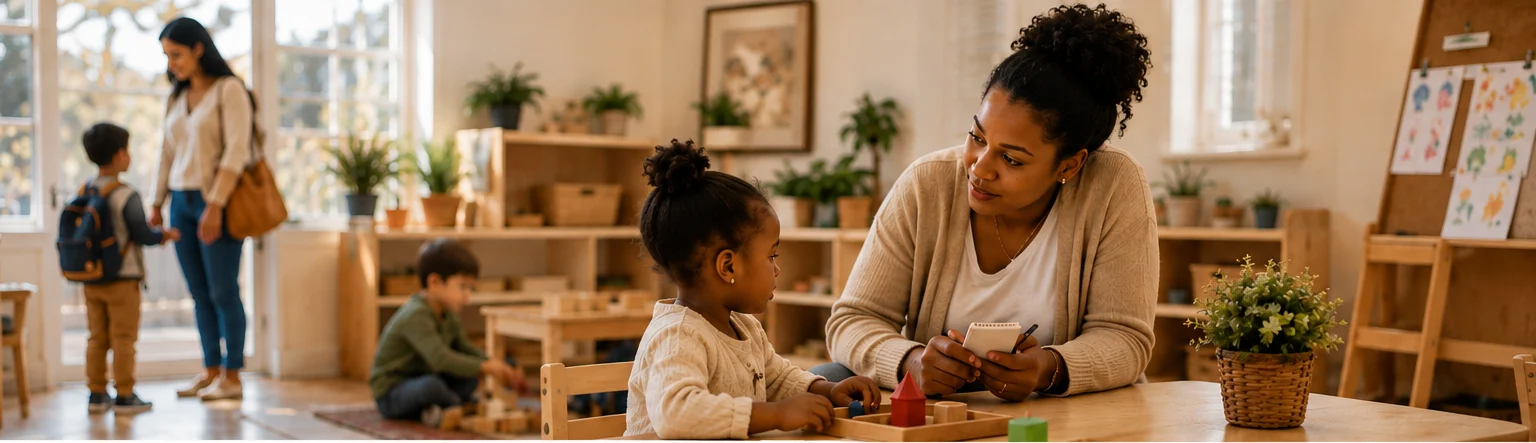
A warm early childhood classroom scene reflecting the connection between family knowledge, educator observation, and thoughtful follow-through. As children engage in the classroom, the educator’s attention to what families share becomes another part of understanding and supporting the whole child.
Years ago, I had a child in my classroom who was learning English.
He loved school.
He participated in activities. He played. He watched what was happening around him. He used visuals in the classroom to communicate, and every now and then we would hear him whisper or talk quietly with another child during play.
But for most of that school year, he did not talk to the teachers.
We would speak to him, ask questions, and invite him into conversations, but we rarely heard his voice.
His mom kept telling us something different.
She would tell us how much he talked at home.
He talked about what we had done at school. He remembered experiences. He shared things that had happened during the day.
She was giving us information about a child we were not fully seeing from inside the classroom.
And that mattered.
Because if we had only looked at what we could hear at school, it would have been easy to create an entire story around his silence.
There were questions.
Was there a language concern?
Was there something else happening?
Why would he talk at home but not with us?
Then over spring break, I took a course at Erikson Institute and learned about what was described as the silent period in second-language development.
I did not walk back into the classroom thinking I suddenly had a label or an answer for this child.
But I did come back with another way to think about what we were seeing.
My teaching assistant and I became more intentional about how we supported his communication and participation.
And we kept listening to his mom.
By the next school year, we were hearing much more of his voice. He was communicating with us in English and in his home language.
When I think back on that experience, what stays with me is not only what I learned in the course.
It is what his mother had been telling us all along.
Her knowledge mattered.
She could see something we could not see from the classroom.
And because she stayed connected with us, we had another piece of the story.
Family knowledge should have somewhere to go.
Listening Is Important. What Happens Next Matters Too.
Early childhood programs ask families a lot of questions.
What does your child enjoy?
How did they sleep?
What helps when they are upset?
What are you noticing at home?
Has anything changed?
What are they talking about lately?
Those questions can be meaningful.
But I think we also need to ask ourselves another question:
What happens after the family answers?
Because receiving information and using information are not the same thing.
A family may tell us what helps their child calm down.
They may explain why their child has suddenly become interested in babies, buses, cooking, or going to the doctor.
They may tell us their child is doing something at home that we have not seen yet at school.
They may share a change in the household, a new word, a new skill, a fear, a routine, a celebration, or something their child keeps talking about.
Not every piece of information needs to become a new lesson plan.
Not everything requires a meeting.
Not everything should be shared with the whole team.
But if we are inviting families into the conversation, what they share should be able to shape what happens next.
Sometimes it changes what we do.
Sometimes it changes what we watch for.
Sometimes it simply helps us understand the child differently.
That counts too.
Sometimes the Example Tells Us More
This is why I like asking families for examples.
There is a difference between:
“Does your child talk about school?”
and:
“What has your child been saying about school lately?”
There is a difference between:
“Does this happen at home?”
and:
“What does this usually look like at home?”
A yes or no gives us information.
But an example gives us context.
Sometimes the example tells us a whole lot more than yes or no ever could.
It gives the family room to tell us what they actually see instead of trying to fit their experience into the answer we expected.
And sometimes that one example changes what we notice the next day.
That does not mean families have all the answers.
Educators bring professional knowledge and classroom observation.
Families bring knowledge built from knowing their child in another setting, across different routines, relationships, languages, and experiences.
Both can matter at the same time.
Good Communication Still Needs a System Behind It
There is another side of this that I have seen plenty of times over the years.
A parent tells someone something during drop-off.
The staff member listens.
They fully intend to pass it along.
Then another child arrives.
Someone needs help.
Breakfast is happening.
The day gets moving.
Later somebody says:
“Oh, I forgot they told me that this morning.”
I understand how that happens.
Early childhood moves fast.
But when it happens repeatedly, families may end up telling the same story to several people because nobody is quite sure where the information went.
That is why good communication still needs a system behind it.
Not a complicated system for every little conversation.
A clear enough pathway for people to know:
Does someone else need this information?
Who is the right person?
Is follow-up needed?
Does this need to be documented?
Does this information need to stay with me because it is private?
Privacy matters here.
Family partnership does not mean every person on the team needs to know everything a family shares.
Sometimes the respectful thing is making sure information does not travel farther than it needs to.
But that makes clarity even more important.
Staff should not have to guess what gets shared, what stays private, and who follows up.
Families should not have to keep repeating something important because the program never decided where it needed to go.
Families Should Know We Notice Their Child
There is another part of family partnership I think we can overlook.
Families should know we notice their child before we need to talk about a concern.
Not just when something happened.
Not only when we need a signature.
Not only when we need to discuss behavior, attendance, development, or a problem.
Families should hear:
“She was so proud of what she built today.”
“He stayed with that puzzle longer than I have ever seen him stay with it.”
“She helped another child.”
“He could not stop talking about the book we read.”
“She tried something new today.”
Those moments matter.
If the first meaningful conversation we have with a family is about something difficult, we have missed opportunities to build relationship before we needed it.
Family partnership grows through the ordinary conversations too.
The moments that say:
I see your child.
I enjoy your child.
I am paying attention.
And when something harder does need to be discussed, that relationship already has somewhere to stand.
“Not Engaged” Is Not Enough Information for Me
I have also learned to be careful when I hear a family described as “not engaged.”
My first thought is usually:
How have we tried to connect?
And then:
What happened when we did?
Families have different schedules, communication styles, comfort levels, experiences with schools and programs, and responsibilities outside of the program.
One family may come to every event.
Another may never be able to attend an event but responds to every message.
Another may talk for five minutes every morning.
Someone else may prefer a scheduled phone call.
A family may be deeply involved in their child’s learning at home in ways we never see.
Family engagement is not one look.
That does not mean programs should stop inviting families or stop creating opportunities for connection.
It means we should be careful about deciding what a family’s absence from one kind of participation means.
Before deciding someone is disengaged, I want to know what we offered.
Did we ask what works for them?
Did we consider their communication preference?
Did we try another format?
Was the invitation really accessible?
Did we only reach out when we needed something?
Sometimes we may find that the family is not disconnected from their child at all.
They simply were not connecting with the program in the way we expected.
That is worth understanding.
Family Knowledge Should Not Have to Start Over Every Time
Imagine sharing something important about your child with one person.
Then having to explain it again to the next person.
Then again.
At some point, you start wondering whether anyone is actually hearing you.
Families should not have to learn who the “right” staff member is through trial and error.
And staff should not have to depend on memory alone to make sure meaningful information reaches the appropriate person.
This is where leadership matters.
Leaders help create the pathway.
Not by turning every family interaction into paperwork.
But by helping teams understand how information moves.
What belongs with the classroom team?
What requires leadership follow-up?
What should be shared with another designated staff member?
What should remain confidential?
Who lets the family know the next step?
Those systems may not be the part of family engagement we put on a flyer.
But families feel them.
They feel the difference between:
“I told them.”
and“They heard me.”
One Place to Begin
You do not need to redesign your entire family engagement system tomorrow.
Start with one recent conversation.
Think about the last meaningful thing a family shared with you.
Where did it go?
Did it help you understand the child differently?
Did it change something you watched for?
Did someone else appropriately need to know?
Was follow-up needed?
Did you follow up?
Or did the information disappear once the day became busy?
There is no assumption that every answer should lead to action.
Sometimes listening carefully is the action.
Sometimes what the family shared simply gives us context we did not have before.
But we should know the difference between intentionally deciding no additional action is needed and important information simply getting lost.
That is the part I want us to pay attention to.
After the Family Shares
I keep thinking back to that child and his mom.
We saw one part of him at school.
She saw another part at home.
Neither of us had to prove the other person wrong.
We needed both pieces.
Her knowledge did not replace what we observed.
What we observed did not cancel what she knew.
Together, we understood more.
That is what family partnership can make possible.
Not because families and educators always see the same thing.
Not because home and school are supposed to look exactly alike.
But because children are bigger than the small part of their lives any one of us gets to see.
So when a family tells us something about their child, I want us to listen.
And then I want us to ask:
What does this help me understand?
Does anything need to happen next?
Who appropriately needs to know?
How will we protect what was shared?
And how will the family know they were heard?
Family knowledge can change what we see—and sometimes, what we do next.
It should have somewhere to go.
That’s what RaChe’ said.
#WhatRaCheSaid
