

What the In-Between Moments Are Showing Us
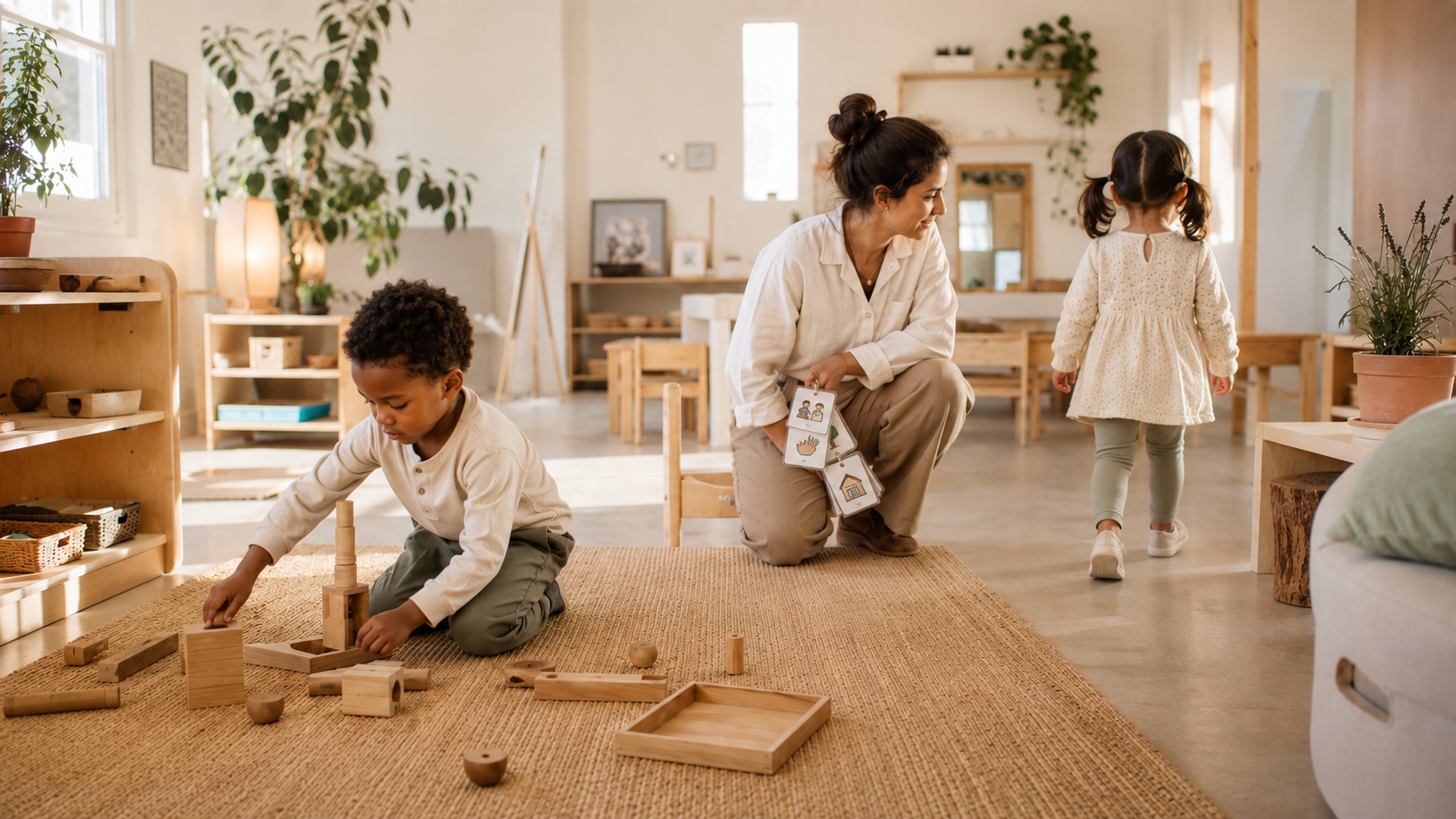
A warm, light-filled early childhood classroom with a diverse group of children and a supportive educator during a transition moment. One child is focused on building with wooden blocks on a natural rug, while another child moves toward the next part of the classroom routine. The educator kneels nearby with a calm, attentive presence, supporting children as they move through the environment. The space features natural wood materials, soft neutral tones, and gentle greenery, reflecting a thoughtful classroom design that supports play, movement, and transitions.
When I first started in early childhood, I thought a good transition meant we got from one thing to the next quickly, quietly, and without too much disruption.
If the children lined up, moved along, and the room did not feel chaotic, I probably would have counted that as a good transition.
And I understand why.
In early childhood, there is always another part of the day waiting. Arrival leads to breakfast. Breakfast leads to cleanup. Cleanup leads to group time. Group time leads to centers. Centers lead to outside. Outside leads to bathroom, handwashing, lunch, rest, and all the other pieces that make the day move.
So yes, when a transition feels smooth, quiet, and quick, it can feel like a win.
But over time, my understanding has changed.
Quiet does not automatically mean a transition is working well.
Fast does not automatically mean better.
And getting from one thing to the next does not always tell us whether children understood, participated, or had the support they needed.
A transition can look simple to us and still ask a lot of a child.
A Transition Is Not Just a Time Block
On a schedule, a transition may only take five minutes.
But inside those five minutes, a child may be asked to stop something meaningful, shift attention, remember what comes next, wait for other children, move through the room, manage materials, follow directions, regulate feelings, and begin again.
That is a lot.
Especially when the child was deeply involved in something.
Especially when the next step is not clear.
Especially when there is waiting.
Especially when adults are giving several directions at once.
Especially when the child needs more time to process the change.
Sometimes we say, “Transitions are hard,” and we are not wrong.
But that cannot be the whole explanation.
Over time, I have learned to ask more specific questions.
What part feels hard?
Who is having difficulty?
How is the transition being supported?
Where does the gap seem to be?
And most of all, I want to observe.
Because what we say is happening and what is actually happening in the moment can be two different things.
A team may say children are not listening, but the room may be giving them too much to process.
A teacher may say a child does not want to line up, but the child may not know what to do with the materials they are holding.
A routine may look smooth from across the room, but one child may be following along without really understanding what comes next.
That is why I do not want us to rush past the in-between moments.
There is information there.
Transitions Are Part of the Learning
I have heard people talk about transitions as if they are lost time.
Almost like learning pauses until children get to the next activity.
But transitions are part of the learning too.
Children are learning how to stop and start.
How to wait.
How to listen.
How to move with others.
How to care for materials.
How to manage belongings.
How to follow a sequence.
How to shift from one idea to another.
How to be part of a group without losing themselves completely inside the group.
That is not empty time.
That is real learning.
The challenge is that adults do not always plan for transitions with the same level of intention we give to the activities around them.
We plan the art experience.
We plan the story.
We plan the small group.
We plan the materials.
Then the transition gets treated like the thing we just need to get through.
But children experience that part of the day too.
And if they experience it over and over again as rushed, confusing, crowded, unclear, or unsupported, that matters.
The Environment Can Help Explain What Happens Next
Adults carry a lot with their voices.
We remind.
We repeat.
We call across the room.
We say it again.
We say it louder.
We say it with more feeling.
And sometimes children do need our words.
But sometimes we are using our voices to carry information the environment could help communicate.
When the environment gives some of the information, adults do not have to carry all of it with their voice.
That might mean the next area is easy to see.
Materials have a clear place to go.
Children know where to wait without being in the middle of traffic.
The path from one part of the room to another makes sense.
A child can see what is available, what is finished, or what happens next.
The support is close enough to use in the moment.
This does not mean the environment does all the work.
Adults still matter.
Relationships still matter.
Guidance still matters.
But the environment should be part of the support.
I believe the adults, the children, and the environment all have a role in transitions.
When all of the responsibility sits on adult reminders, transitions can become exhausting for everyone.
Support Has to Show Up Somewhere
This is where my consultant mind always goes.
A plan may look strong on paper.
A team may have talked through a strategy.
A teacher may have attended training.
A support may be listed, discussed, or written down.
But the question is still:
Where does the child actually experience it?
The tool is not the goal. The support is what the child actually experiences.
If a child needs help understanding what comes next, where does that help show up?
If a child needs fewer steps, where did we simplify the steps?
If a child needs more time, where did we build in time?
If a child needs an adult nearby, who knows that is their role?
If the plan says the child needs support during transitions, what would we actually see during the transition?
That gap between what adults plan and what children experience matters to me because best practice should not live only in our paperwork or our intentions.
It has to become something children can feel, use, and participate in.
We say children learn through play, and I believe that deeply.
But sometimes people hear that and think only about choice time or free play.
Children are learning all day.
They are learning in routines.
They are learning during waiting.
They are learning when they put on coats.
They are learning when they clean up.
They are learning when they move from outside to inside.
They are learning when an adult helps them understand, “This is ending, and something else is beginning.”
Support has to show up somewhere in those real moments.
Outdoor Time Teaches Us a Lot About Transitions
Outdoor transitions are one of those parts of the day that can show us just how much children and adults are carrying.
There may not be much time.
The schedule may be tight.
Safety matters.
Zoning matters.
Counting matters.
Supervision matters.
Then add coats, hats, gloves, shoes, bathroom needs, children moving at different speeds, and somebody suddenly remembering they left something behind.
That is not a small transition.
That is a whole production.
And yet outdoor time still matters.
A hard transition does not automatically mean we skip what children need.
It means we need a meaningful plan.
Not a perfect plan.
Not a plan so rigid that nobody can breathe.
A meaningful plan.
Who is helping children get ready?
Where do children wait?
What can they do while they wait?
What does the environment show them?
What can children do independently?
Who needs more support?
How do adults stay connected to safety without turning the whole moment into stress?
When we look at the transition that way, we stop treating it as an inconvenience and start seeing it as part of the teaching.
Endings Need Support Too
Sometimes the hardest part of a transition is not starting the next thing.
It is ending the thing that finally became meaningful.
Early childhood will humble you with this one.
You give the two-minute warning.
You think you are being helpful.
Then suddenly the child who has been near the blocks for twenty minutes has a full construction plan, a new idea, and a very serious need for more time.
Now you are negotiating with a tiny project manager.
And honestly, sometimes they make a good point.
Because from the adult side, we may see, “It is time to clean up.”
But from the child’s side, the idea may have just come together.
The building finally works.
The pretend story finally has roles.
The drawing finally looks the way they wanted it to look.
The child is not necessarily trying to make the transition harder.
They may be deeply invested.
Endings are part of the learning too.
That does not mean every experience can continue forever.
Schedules matter.
Meals matter.
Rest matters.
Families arrive.
The day has to move.
But we can still respect that ending something meaningful may require support.
Acknowledge the work.
Offer a way to return when possible.
Help the child name what they were doing.
Give a clear next step.
Make the ending feel less like everything disappeared.
Children do not only need help getting started.
Sometimes they need help letting go.
Families May Already Know Something Useful
Families often know how their child handles endings and changes in ways we may not see at school.
They may know that their child needs time before leaving the house.
They may know a certain phrase helps.
They may know their child watches quietly before joining something new.
They may know that sudden changes are hard, or that their child does better when they can carry a small job into the next moment.
Home and school do not have to look the same.
Family knowledge does not mean educators have to copy every home routine.
But it can help us understand the child more fully.
Family knowledge can help us understand what support looks like before we start guessing.
A simple question can open that door:
“What helps your child shift gears?”
“What seems to make endings easier?”
“What do you notice when routines change?”
“What helps when your child needs to stop something they enjoy?”
Those answers may not give us a complete plan, but they may give us a better place to begin.
Leaders Help Define What Success Looks Like
I also think leaders have an important role in how teams understand transitions.
Because programs often reveal what they value by what they measure.
If we only celebrate the transition because it was fast, quiet, and looked smooth from the outside, we may miss other important questions.
Did children understand what was happening?
Were they able to participate?
Was the waiting reasonable?
Did adults know their roles?
Did the environment help?
Did children have access to the support they needed?
Did the transition work for the people moving through it, or did it only look good from across the room?
I want to know whether the transition works for the people moving through it—not just whether it looks smooth from the outside.
That does not mean smooth transitions are bad.
It does not mean quiet is bad.
It does not mean every transition has to be slow.
It means speed alone is not enough information.
A quiet line can look successful and still not tell the whole story.
A louder transition can still include engagement, purpose, and participation.
A slower transition may not be a problem if children are learning what to do and adults are supporting them well.
And faster is not automatically a problem either if children understand what is happening, can participate, and have the support they need.
Leaders can help teams ask better questions.
Not just, “How do we make this faster?”
But:
“What is this moment asking of children?”
“What is the environment communicating?”
“Where are adults positioned?”
“Where is the waiting?”
“What part keeps breaking down?”
“What support is already working?”
“What could be clearer?”
Those questions create a different kind of conversation.
Start With the Part That Keeps Asking for Attention
Start with the part of the day that keeps asking for your attention.
We do not have to fix every transition at once.
That usually becomes too much.
Maybe it is cleanup.
Maybe it is lining up.
Maybe it is coming inside from outdoor play.
Maybe it is handwashing before meals.
Maybe it is moving to rest.
Maybe it is the part of the day where adults repeat themselves the most.
Start there.
Watch before deciding.
What are children being asked to manage?
What is clear?
What is confusing?
Where is the waiting?
What does the environment explain?
What are adults carrying with their voices?
What does the child seem to understand?
What might families know?
What support is actually available in the moment?
The answer may not be another strategy.
It may be more clarity.
A better adult role.
A shorter wait.
A clearer space.
A smaller step.
A way for the child to participate instead of only comply.
A reminder that comes before frustration builds.
A plan that respects both the schedule and the child’s experience.
Transitions are not just the spaces between the important parts of the day.
They are part of the day.
They show us how children understand, participate, wait, shift, belong, and begin again.
So before we call a transition hard and rush toward another solution, maybe we can pause long enough to ask:
What is this moment showing us?
The next step may already be there.
That’s what RaChe’ said.
#WhatRaCheSaid
