

Little Choices, Big Confidence: Don’t Rush the Growth You’re Trying to Support
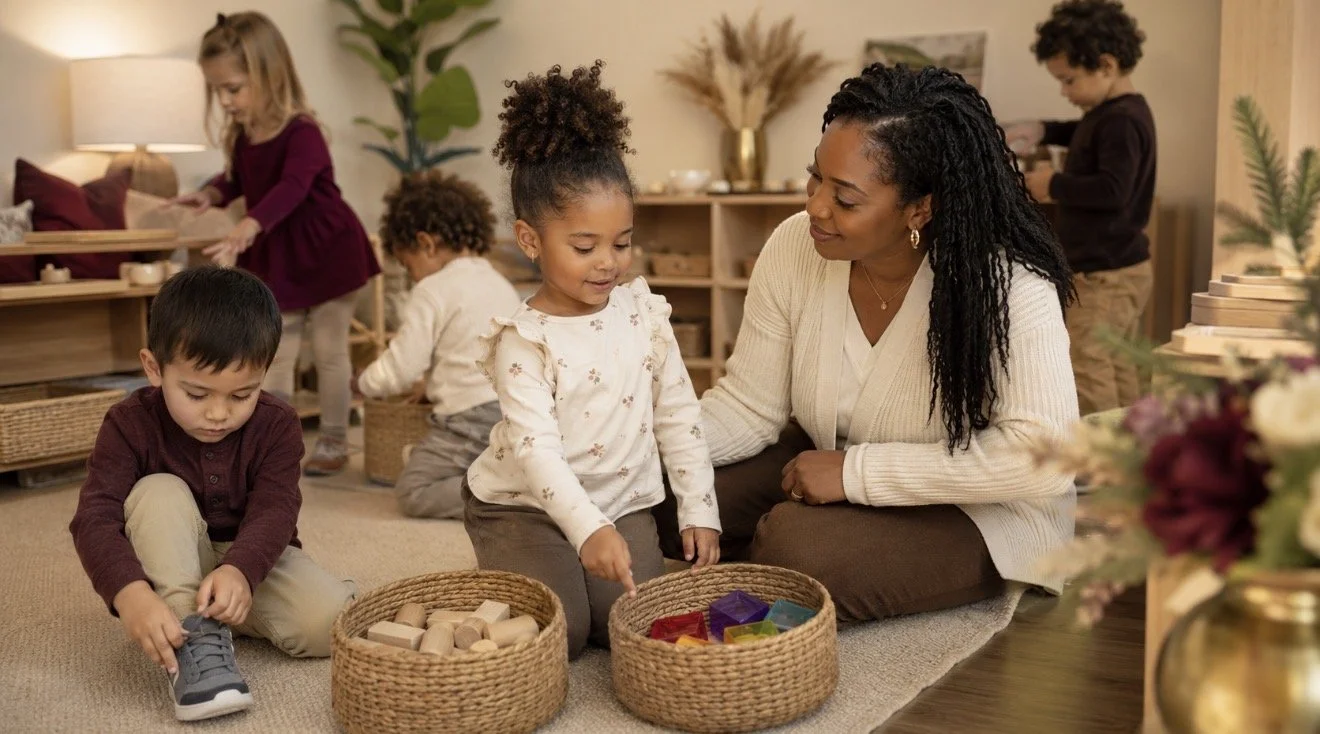
A warm early childhood classroom scene showing an educator sitting beside a young child as the child makes a choice between two baskets of learning materials. Other children are engaged in independent tasks nearby, including tying a shoe, exploring classroom materials, and participating in play. The image reflects supportive independence, meaningful choices, confidence-building, and relationship-centered early childhood practice.
Last week, I kept coming back to children’s confidence.
Not the loud kind of confidence.
Not the kind where a child looks fearless, does everything on their own, and never needs help.
I mean the quiet kind.
The child who tries to zip their coat before asking for help.
The child who reaches for the cup and spills a little water, but still wants another turn.
The child who picks between two cleanup jobs and feels proud because they got to decide.
The child who says, “Help me,” even though just a few minutes earlier they were very clear that they could do it by themselves.
That kind of confidence.
The kind that builds slowly.
The kind that can be easy to miss if we are only looking for children to complete the whole task, do it quickly, or get it right the first time.
And honestly, that is why this topic sat with me the way it did.
Because in early childhood, we talk a lot about independence. We want children to become capable. We want them to participate in routines, take care of their belongings, solve small problems, make choices, and feel proud of what they can do.
All of that matters.
But sometimes, without meaning to, we can start treating independence like it means children should not need us.
And that is not how young children grow.
Children can be capable and still need support.
They can want to try and still need reassurance.
They can be independent in one moment and unsure in the next.
They can know how to do something and still not have the patience, energy, confidence, or emotional regulation to get through it that day.
That does not mean they are behind.
That means they are children.
And the way we respond in those small moments matters more than we sometimes realize.
Because children are not only learning how to zip a coat, pour water, put on shoes, clean up toys, or choose a classroom job.
They are also learning something about themselves.
They are learning:
Can I try hard things?
Will someone help me without taking over?
Is it okay to need support?
Do adults believe I can grow?
Do I have a voice here?
Am I capable, even when I am still learning?
That is the deeper part.
The routine may look small to us, but to the child, it can become a moment where confidence either grows or shrinks.
Independence Should Not Feel Like Pressure
I think we have to be careful with the way we talk about independence.
Because yes, children need opportunities to do things for themselves. They need real chances to participate, make choices, practice, problem-solve, and experience the pride that comes from doing part of something on their own.
But independence should not feel like pressure.
It should not sound like:
“You’re big now. You should know how to do this.”
“You need to do it by yourself.”
“Stop asking for help.”
“You did it yesterday, so why can’t you do it today?”
I know those words can come out when adults are tired, rushed, or trying to keep the day moving. I understand that. Early childhood classrooms are full of pressure. There are transitions, meals, diapers, toileting, naps, cleanup, documentation, behaviors, ratios, family communication, and a whole lot happening at the same time.
But children feel the difference between being encouraged and being pressured.
They feel the difference between, “I believe you can try,” and “You should already know this.”
And that difference matters.
Confidence does not grow because a child is pushed to perform independence before they feel safe enough to practice it.
Confidence grows when children are given room to try, make mistakes, receive support, and try again without feeling ashamed.
That is the part I want us to hold on to.
We are not just teaching children to complete tasks.
We are helping them build a relationship with effort.
A relationship with support.
A relationship with trying again.
A relationship with themselves.
The Pause Matters
One of the hardest parts of this work is knowing when to help and when to wait.
Because sometimes a child truly needs support.
And sometimes we step in because we are in a hurry.
That is real.
I do not say that with judgment. I say it because everyone who has worked in early childhood knows the feeling. You see a child struggling with a zipper, and you also know lunch is waiting, another child needs help, someone is crying, and the schedule is already slipping.
So yes, sometimes we help quickly because the day is moving.
But there are also moments when we can pause.
Not forever.
Not in a way that leaves a child frustrated or overwhelmed.
Just one small pause before we take over.
That pause can communicate something powerful:
I see you trying.
I believe you can work through part of this.
I am close if you need me.
I am not going to rush in and take this from you too quickly.
That is a gift to a child.
Because confidence does not come from adults disappearing.
It comes from adults staying close while leaving space for the child to participate.
That is the balance.
Close enough to support.
Patient enough not to take over.
Support Does Not Cancel Independence
This is one of the biggest messages from last week:
Support does not cancel independence.
A child may need a reminder.
A model.
A visual cue.
A smaller step.
Help with one part.
A hand nearby.
A little more time.
A chance to try again later.
That still counts.
Sometimes we act like independence only matters if the child completes the whole task alone from beginning to end.
But what about the child who puts on one shoe?
The child who chooses their cup?
The child who carries their plate to the table?
The child who starts cleaning up but needs help finishing?
The child who says, “Can you show me?” instead of giving up?
The child who reaches for the zipper, tries, gets stuck, and then looks to the adult for reassurance?
That is growth too.
And sometimes the most supportive thing we can do is help with the part that is getting in the way, then give the task back.
Not take over the whole thing.
Not make the child start from zero.
Just support the part that helps them stay in it.
That is where children begin to feel, “I can do some of this.”
And “some of this” is not small.
“Some of this” is the beginning of confidence.
Little Choices Can Build Big Confidence
I also talked last week about giving children two meaningful choices.
Not ten choices.
Not a wide-open question that turns into a full negotiation.
Just two honest options that both work for the adult.
“Do you want to put away the blocks or the animals?”
“Do you want to walk to the table or hop to the table?”
“Do you want the blue cup or the green cup?”
The routine is still happening.
The expectation is still clear.
But the child gets a voice.
And that matters.
Children do not need to control the whole day to feel powerful. Sometimes one small choice helps a child feel respected, included, and capable.
But we also have to be honest with our choices.
If something is not really optional, we should not present it like it is.
If cleanup has to happen, asking, “Are you ready to clean up?” may turn the routine into a debate we did not mean to start.
And then we get frustrated because the child answered the question we gave them.
That is a moment for adult reflection, not just child correction.
The work is not just offering choices.
The work is offering honest choices.
Choices with boundaries.
Choices that support the routine.
Choices that let children participate without handing them responsibility they are not developmentally ready to carry.
That is respectful teaching.
That is clear teaching.
That is confidence-building teaching.
Families Are Already Supporting Confidence at Home
This message is not only for classrooms.
Families are already helping children build confidence in everyday life, even if they do not call it independence practice.
A child helping stir something in the kitchen.
Putting socks in a drawer.
Choosing pajamas.
Carrying a small bag.
Helping wipe the table.
Picking a book.
Trying to brush their teeth before the adult finishes the job.
Pouring something, spilling a little, and trying again.
Those moments count.
And I think this matters because family engagement can sometimes become one more thing for families to do. One more activity. One more project. One more set of instructions. One more thing to buy, print, prepare, photograph, and send back.
But families are already teaching children through real life.
Family engagement should help families notice the learning that is already happening.
It should not make them feel like they have to recreate the classroom at home.
Not everything has to become a lesson.
Sometimes the most supportive message we can offer families is simple:
Let them help with one small part.
Let them choose between two things.
Let them try before you step in.
Notice the effort, not just the result.
Give them time when you can.
Help with the hard part and let them finish what they can.
That is practical.
That is respectful.
That is real life.
And that is the kind of family engagement I believe in.
Independence Looks Different for Every Child
This part matters deeply.
Independence does not look the same for every child.
Some children use words.
Some use gestures.
Some use pictures, signs, communication devices, movement, facial expressions, or behavior to communicate what they need.
Some children need more time.
Some need repetition.
Some need adult closeness before they are ready to try.
Some are confident with physical tasks but need more support socially.
Some can make choices easily but struggle when it is time to transition.
Some can do something one day and need help the next.
That does not make their growth less valuable.
We have to be careful not to measure independence by how little support a child uses.
Sometimes the support is part of the independence.
Sometimes asking for help is independence.
Let me say that again because I think we forget it.
Asking for help is a skill too.
A child who can say, “I need help,” is learning communication.
They are learning trust.
They are learning problem-solving.
They are learning that they do not have to fall apart to receive support.
That is not weakness.
That is growth.
And when we honor that, we make room for more children to be seen as capable—not only the children who are already verbal, fast, confident, compliant, or easy to understand.
Every child deserves support that sees their effort.
Every child deserves adults who look for the growth underneath the behavior.
What I Want Educators to Hold On To
I do not want educators to read this and feel like they need to create a whole new independence plan for every child tomorrow.
Start smaller than that.
Notice one moment where you usually step in quickly.
Pause.
Ask yourself:
Does this child need me to do it, or do they need a little more time?
Does this child need the whole task done for them, or just help with one part?
Is there a way to support the attempt without taking over?
Then notice one moment where a child is trying.
Not doing it perfectly.
Not doing it quickly.
Not finishing the whole thing.
Just trying.
Support that attempt.
You might offer one prompt.
You might model one step.
You might give a visual cue.
You might say, “I see you working on it.”
You might help with the hard part.
You might stand nearby and let them keep going.
That is enough to begin.
I also want educators to stop treating small progress like it does not count.
One less reminder counts.
One more attempt counts.
One child asking for help instead of giving up counts.
One child choosing how to participate counts.
One child trying again tomorrow counts.
One child watching today and joining next time counts.
This work is full of small moments that may never make it into a report, a photo, or a lesson-plan box.
But they matter.
They matter because children are building a sense of who they are.
And for some children, the belief “I can try” begins with one adult who did not rush them.
What I Want Leaders to Think About
For directors, coaches, and program leaders, this conversation is bigger than children putting on coats, pouring water, choosing cups, or cleaning up toys.
This is about classroom culture.
This is about what we value.
This is about what we make room for.
Are teachers supported to slow down and let children participate?
Or are routines so rushed that independence becomes one more thing to “get done”?
Are we praising teachers only when transitions are fast, quiet, and perfectly controlled?
Or are we also noticing when teachers pause, prompt, model, wait, and help children build real skills?
Because supporting independence takes time.
It can look messy.
It can slow down the routine.
It can look like spills, repeated attempts, unfinished zippers, crooked shoes, and children taking longer than adults would prefer.
But that does not mean learning is not happening.
Sometimes that is exactly what learning looks like.
If we want teachers to support children’s confidence, we have to give teachers permission to let growth happen in small, imperfect ways.
Leaders set the tone for that.
A program cannot say it values independence and then rush every routine so much that children never get to practice.
A program cannot say it values confidence and then only celebrate children when they get everything right.
A program cannot say it values responsive teaching and then give teachers no room to respond.
So part of this reflection is for leaders too.
Look at the pace of the day.
Look at what teachers are praised for.
Look at whether routines leave any room for children to try.
Look at whether staff feel supported when growth looks slow, messy, or unfinished.
Because the culture adults work in affects the kind of culture they can create for children.
Don’t Rush the Growth
Last week kept bringing me back to one thought:
Do not rush the growth you are trying to support.
That applies to children.
And honestly, it applies to adults too.
Growth takes time.
Confidence takes time.
Learning when to step in and when to step back takes practice.
No shame. Just reflection.
We will not always get it right.
Sometimes we will help too fast.
Sometimes we will wait too long.
Sometimes we will offer a choice that was not really a choice and realize it halfway through the sentence.
Sometimes we will rush because the day is rushing us.
That is real.
But the reflection matters.
The pause matters.
The willingness to see children as capable and still deserving of support matters.
Because confidence does not grow from pressure.
It grows from practice.
It grows from trust.
It grows from small choices.
It grows from supported attempts.
It grows when a child learns, again and again:
I can try.
I can ask for help.
I can make a choice.
I can do part of this.
I am still learning, and I am still capable.
So as we move into a new week, carry this with you:
Support the attempt.
Notice the growth.
Let confidence build step by step.
That’s what RaChe’ said.
#WhatRaCheSaid
