

Play More, Pressure Less: Let Meaningful Be Enough
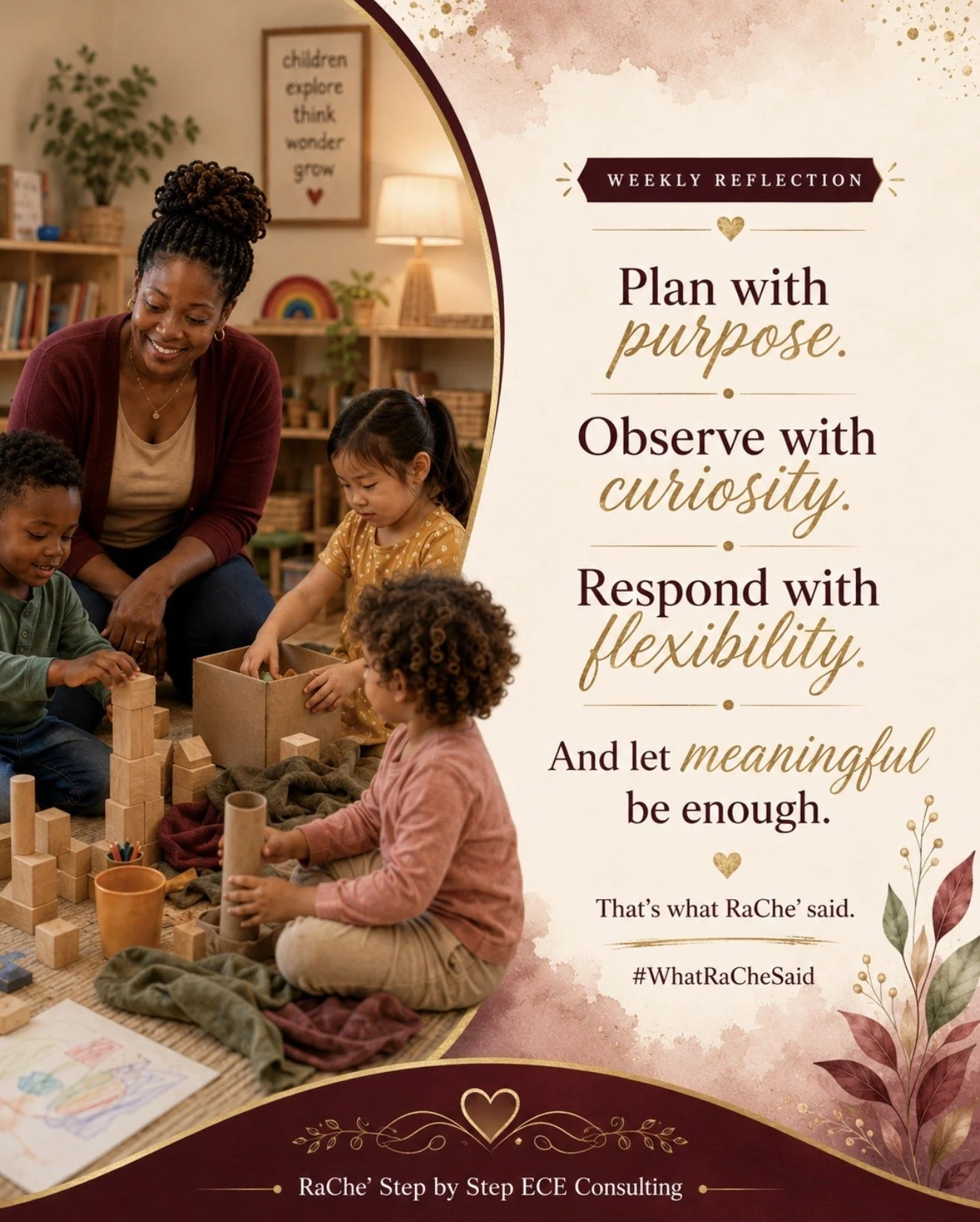
Weekly Reflection: Play More, Pressure Less. Plan with purpose, observe with curiosity, respond with flexibility, and let meaningful be enough.
This week, I talked a lot about simple play, open-ended materials, responsive teaching, and letting go of the pressure to make every experience look impressive.
I chose this topic because I believe many early childhood educators are carrying unnecessary pressure.
The pressure to create something new every day.
The pressure to make the classroom look perfect.
The pressure to prepare activities that photograph well.
The pressure to prove that children are learning by producing something adults can see, display, or send home.
And sometimes, without even realizing it, we begin measuring the quality of an experience by how much time the adult spent preparing it.
That is not always the same thing as meaningful learning.
I am not against beautiful classrooms, creative activities, or thoughtful preparation. I enjoy those things too. Planning matters.
But we have to be careful that the activity does not become more important than the child.
Why This Conversation Matters
Early childhood educators are already carrying a lot.
They are managing routines, assessments, family communication, classroom behaviors, documentation, lesson planning, transitions, cleaning, supervision, and everything else that comes with caring for a group of young children.
When we add the expectation that every experience must also be elaborate, creative, new, and visually impressive, we can create more stress without necessarily creating better learning.
Sometimes we are doing more work around the activity than children are doing within the activity.
That is one reason this conversation matters.
Another reason is that children deserve room for their own ideas.
When every material has one expected outcome, every step has been decided by the adult, and every finished product is supposed to look the same, there may be little room left for children to make decisions, solve problems, take risks, or create something unexpected.
Children may complete the activity, but completion alone does not tell us how deeply they were thinking.
That is why I keep saying:
Purpose first. Activity second.
The activity is not the goal.
The activity is one possible way to support the goal.
Simple Does Not Mean Unintentional
I also want to be clear about something.
“Play more, pressure less” does not mean we stop planning.
It does not mean teachers should place random materials on a table and hope something meaningful happens.
It does not mean we lower expectations or remove the educator from the learning process.
Intentional teaching still requires thought.
It requires educators to know why they are offering an experience, what they are noticing, what children may be trying to understand, and when support is needed.
But intentional teaching also requires flexibility.
Sometimes children use a material differently than we expected.
Sometimes the cardboard box becomes more important than the activity we spent 45 minutes preparing.
Sometimes the original plan is no longer where the strongest learning is happening.
That does not automatically mean the lesson failed.
It may mean the children gave us new information.
The professional work is deciding what to do with that information.
What I Want Educators to Do With This Message
As I close this topic, I do not want educators to throw away their lesson plans or stop preparing meaningful experiences.
I want educators to pause.
Before preparing another complicated activity, ask:
What is the purpose of this experience?
Think about what you want children to explore, practice, communicate, or understand.
Then consider whether the activity you selected actually supports that purpose—or whether it is creating more work than meaning.
I also want educators to watch children differently.
Look beyond what they made.
Notice what they tried.
What choices did they make?
What problem were they working through?
Did they change their approach?
Did they ask for help?
Did they include another child?
Did they keep going when something did not work?
That is where a lot of the learning lives.
And when children take an experience in another direction, I want educators to feel permission to be responsive.
You can adjust.
You can pause.
You can follow the idea a little longer.
You can decide that the learning happening in front of you is more meaningful than completing every step of the original plan.
The plan should guide you.
It should not blind you.
What I Want Leaders to Consider
This message is also for directors, coaches, education managers, and program leaders.
We have to think about the expectations we create for teachers.
Are we praising thoughtful observation and responsive teaching?
Or are we mostly noticing decorations, displays, finished products, and how busy the classroom looks?
Are teachers being encouraged to explain the learning they observed?
Or do they feel like they have to constantly create something new to prove they are doing their jobs?
Leaders help shape what teachers believe quality looks like.
When teachers feel pressured to perform quality instead of understand it, everyone loses something.
Children lose time to explore.
Teachers lose energy.
And programs may end up with beautiful products without a clear understanding of the learning process behind them.
This Is Also an Equity Conversation
This topic matters for families too.
Family engagement should not require a shopping trip, special materials, a printer, a large living space, or extra time families may not have.
Families do not need to recreate the classroom at home.
Meaningful learning already happens through conversations, routines, family stories, songs, cooking, sorting, walking, pretending, building, and spending time together.
When programs offer family activities, we should ask whether those ideas feel accessible and respectful—or whether they feel like one more assignment.
Meaningful family engagement should build connection, not pressure.
What I Hope We Carry Forward
I hope educators leave this week feeling a little lighter.
Not less responsible.
Not less intentional.
Just less pressured to prove learning through perfection.
I hope teachers feel encouraged to use familiar materials with fresh eyes.
I hope they listen a little longer.
Observe a little more closely.
Leave more room for children’s ideas.
And recognize that a quiet, ordinary moment can still be full of learning.
I hope leaders give teachers space to explain what they noticed, not only display what children produced.
And I hope programs continue finding ways to support families without adding unnecessary cost, pressure, or complication.
There is more to explore here.
How do we plan open-ended experiences without becoming too hands-off?
How do we document learning when there is no finished product?
How can leaders coach teachers to recognize complex thinking during simple play?
How do we balance curriculum expectations with children’s emerging ideas?
Those are the deeper conversations I will continue through upcoming learning sessions, resources, and professional development.
For now, I want us to begin with one reminder:
You do not have to make every experience bigger.
You do not have to add more because simple feels too simple.
You do not have to prove that learning happened by creating the perfect picture.
Plan with purpose.
Observe with curiosity.
Respond with flexibility.
And let meaningful be enough.
That’s what RaChe’ said.
#WhatRaCheSaid
