

Relationships Hold the Routine: Why Connection Comes Before Correction
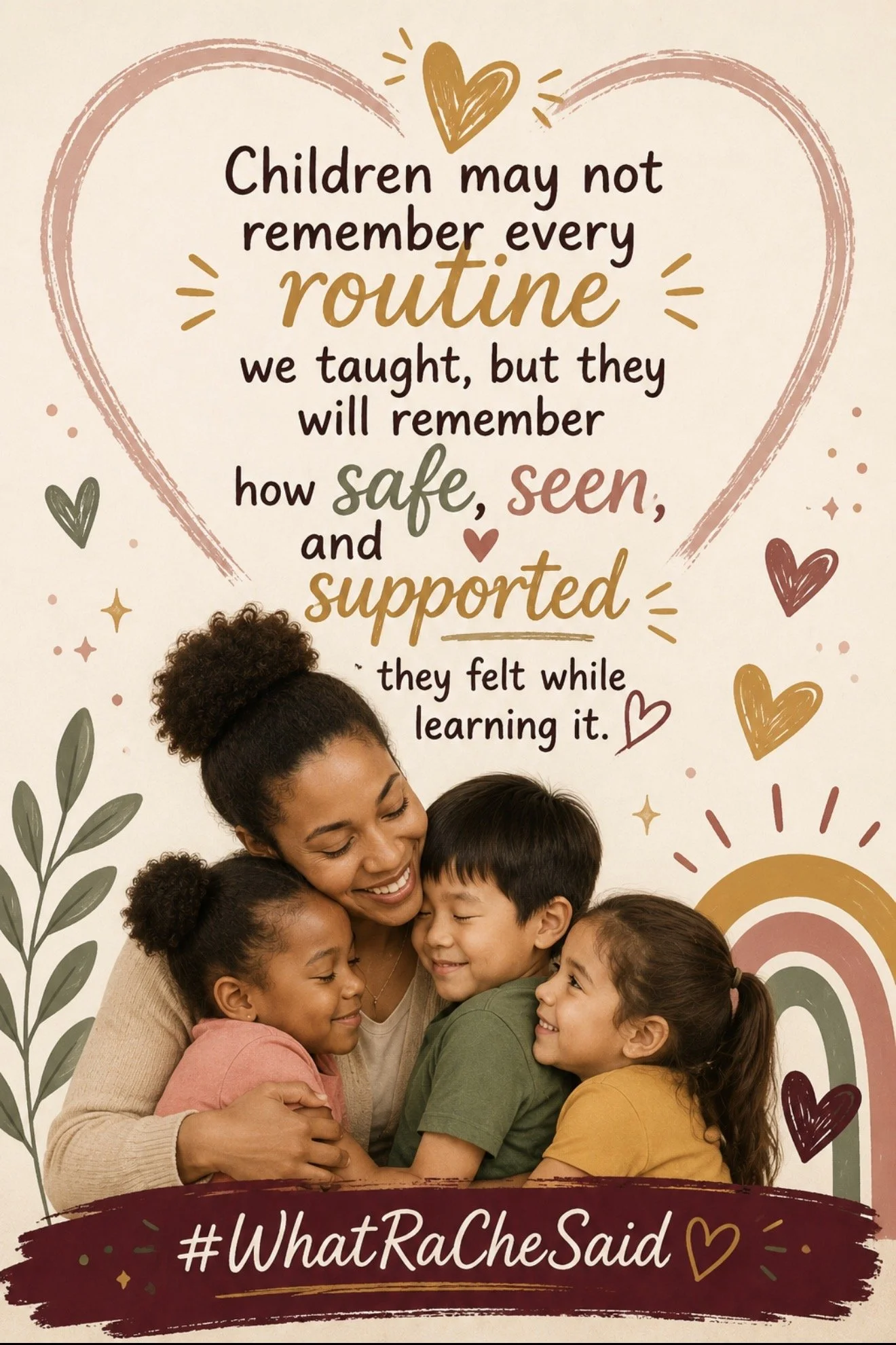
Children may not remember every routine we taught, but they will remember how safe, seen, and supported they felt while learning it.
That reflection stayed with me last week because I continue to see so many early childhood educators struggling with what we often call classroom management.
Teachers are working hard. They are repeating directions, redirecting children, creating visual schedules, adjusting activities, and trying different behavior strategies. Yet many still feel like nothing is working.
When the same behaviors continue, it is easy to assume that the children or their behaviors are the problem.
But sometimes, behavior is not the place where we need to begin.
Sometimes, we need to look more closely at the relationships, routines, expectations, and support surrounding the behavior.
Behavior Is Communication
Young children are still learning how to communicate their needs, manage strong emotions, wait, transition, solve problems, and participate in a group.
What adults describe as challenging behavior may be a child communicating:
I do not understand what is expected.
I am having trouble with this transition.
I do not feel connected yet.
I need more support.
This routine is moving too quickly for me.
I do not have the words or skills to manage this moment.
This does not mean we ignore behavior. It means we become curious about what the behavior may be communicating before moving directly into correction.
Children still need limits, structure, guidance, and clear expectations. However, those things are most effective when they are supported by trusting relationships and consistent routines.
Relationships Hold the Routine
Routines help children understand what happens next. Relationships help children feel safe enough to participate in what happens next.
We need both.
A classroom may have a beautiful visual schedule, clearly labeled centers, planned transitions, and written expectations. But when children do not feel connected to the adults guiding those routines, the systems may not work the way we hoped.
Connection is what helps the routine become meaningful.
When a teacher gets on a child’s level, uses the child’s name calmly, acknowledges a feeling, offers a simple choice, or takes a moment to reconnect after a difficult experience, that teacher is doing more than managing behavior.
The teacher is building safety.
When children feel safe, seen, and supported, they are more available for learning.
Connection Before Correction
Connection before correction does not mean allowing children to do whatever they want.
It does not mean avoiding boundaries.
It does not mean teachers should never redirect behavior.
It means we guide children through relationships rather than relying only on control, consequences, or repeated commands.
Sometimes connection sounds like:
“I see that you are having a hard time stopping.”
Sometimes it sounds like:
“Would you like to walk to the table or hold my hand?”
Sometimes it means moving closer, lowering our voice, protecting the child’s dignity, and having the conversation away from peers.
Sometimes it means repairing the relationship after a difficult moment.
Children do not need perfect teachers. They need adults who are willing to reconnect, reflect, and try again.
Before We Add Another Behavior Strategy
When classroom management feels difficult, I encourage educators and leaders to pause and ask:
Are the routines clear, consistent, and developmentally appropriate?
Have children had enough time and support to practice them?
Are adults responding consistently across the classroom?
Do children feel known and connected to the adults guiding them?
Are we teaching the skill we want to see, or are we only correcting the behavior we do not want?
Are transitions, long wait times, or environmental expectations contributing to the challenge?
These questions are not about blaming teachers. They are about supporting teachers.
Many educators have been given behavior expectations without receiving enough coaching, planning time, modeling, or practical tools to create the conditions children need.
Teacher support must go beyond saying, “You need better classroom management.”
We have to help educators examine what is happening, reflect on the routine, strengthen the relationship, and identify the next practical step.
A Simple Place to Begin
Choose one routine that is currently difficult.
It may be arrival, cleanup, handwashing, meals, rest time, lining up, or moving between activities.
Instead of trying to fix the entire day, focus on that one routine.
Ask yourself:
What is the child expected to do?
Has that expectation been clearly taught and practiced?
What usually happens right before the behavior?
How are adults connecting with children during this part of the day?
What small adjustment could make the routine feel more predictable and supportive?
Small changes matter.
A visual cue, a shorter wait, a consistent phrase, a calm choice, a familiar song, or a few moments of individual connection may change how a child experiences the routine.
The goal is not simply immediate compliance.
The goal is helping children build skills while feeling safe and connected.
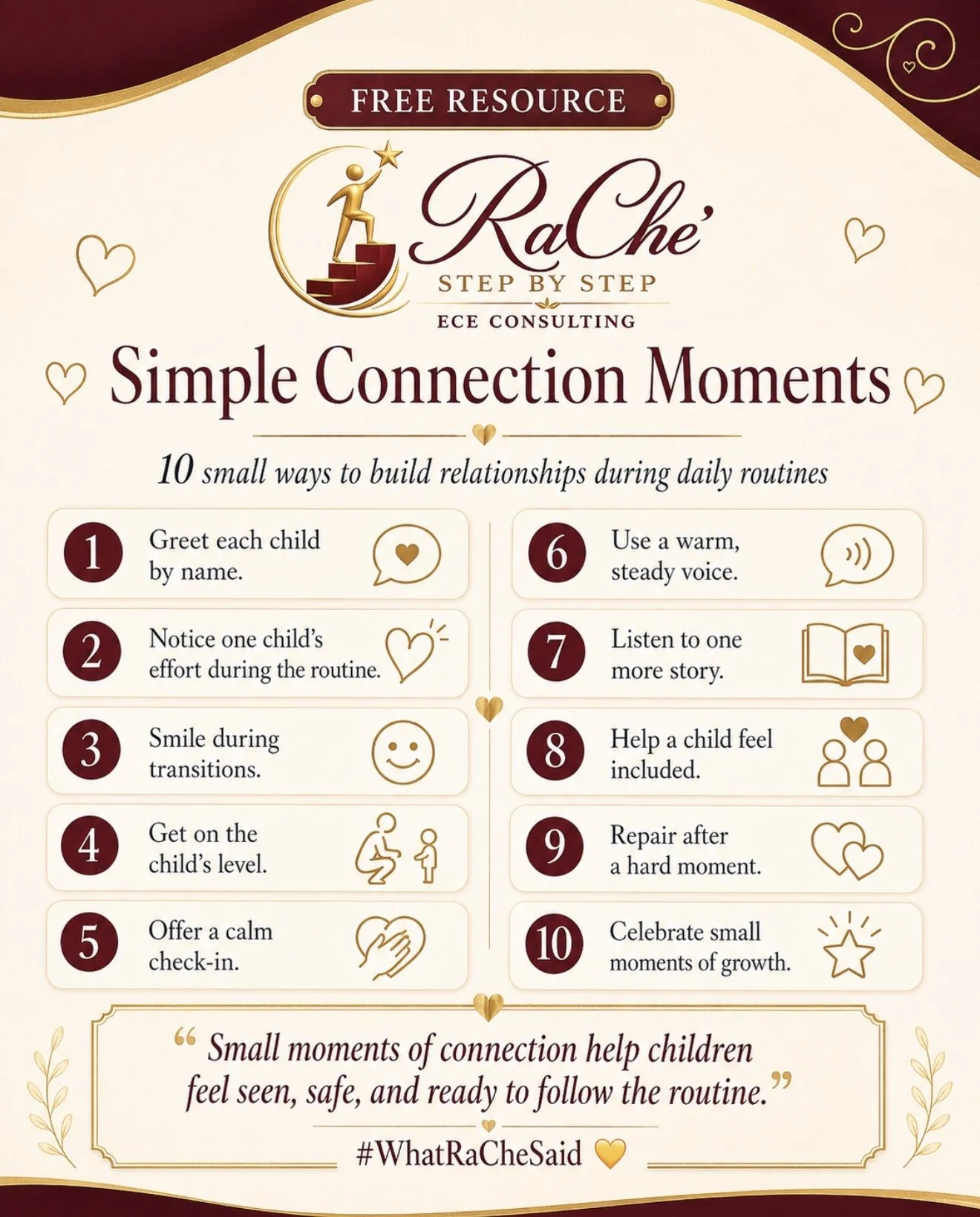
A Free Resource for Educators and Leaders
To support this reflection, I created a free resource:
Connection Before Correction: 10 Simple Ways to Build Connection Before Redirecting Behavior
This resource includes practical reminders educators can use throughout the day, including getting on the child’s level, acknowledging feelings, offering choices, using a calm voice, protecting dignity, and repairing after difficult moments.
These are simple strategies, but simple does not mean insignificant.
The way we approach children during challenging moments matters.
The Reflection I Am Carrying Forward
Children may not remember every direction, transition song, classroom rule, or routine we taught.
But they will remember how they experienced us.
They will remember whether they felt noticed.
They will remember whether they felt safe making mistakes.
They will remember whether an adult stayed connected while helping them learn.
Routines provide structure. Relationships provide the foundation that helps that structure hold.
Before we decide that the behavior is the problem, let’s pause and consider what the routine, environment, relationship, or system may be asking us to strengthen.
That is where meaningful change often begins.
#WhatRaCheSaid
